
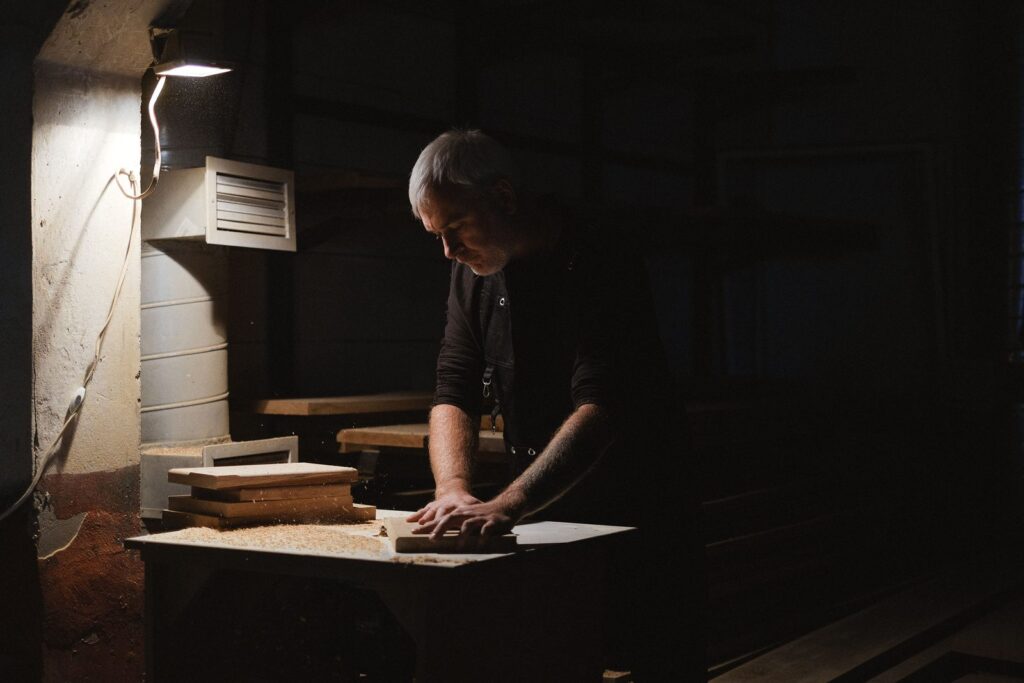
The Architect Who Builds Without Anyone Watching. The Integrity of Work Performed in Absence of Audience.
The quiet builder is the architect whose work proceeds without audience.
The work is not hidden. It is not secret. It is not the work of the disappearing operator (Volume I), who has engineered absence as posture. The quiet builder simply does not produce the visible artefacts the operator economy expects. The work is performed. The architecture is engineered. The substance accumulates. The audience does not assemble.
This essay is the Sunday flagship of Volume V. The intellectual high water mark of the week. We will sit with the substance of the quiet builder slowly, as the Sunday register asks. We will distinguish the quiet builder from related but different postures. We will trace the structural conditions under which quiet building becomes possible and the conditions under which it becomes impossible. We will examine why the work performed without audience often carries a structural integrity the audience driven work cannot achieve. And we will close, as the volume closes, with the doctrine of the quiet builder.
The piece is for the architect who has been quietly building and has begun to wonder whether the quietness is, in fact, the substance. It is also for the architect who has not yet recognised that the most valuable work in their career may be the work that no one is watching.
What the quiet builder is not
Several postures look like quiet building and are not.
The quiet builder is not the operator who has failed to attract attention. Failure to attract attention is the operator’s inability to perform the substance that would attract it. The quiet builder is the architect whose substance could attract substantial attention and who has structured the work in ways that do not produce the attention.
The quiet builder is not the disappearing operator (Volume I). The disappearing operator has engineered absence as a deliberate posture, with the four layers of structural invisibility. The quiet builder may operate publicly, may have a name in the relevant industries, may participate in the rooms that matter. The quietness is not the absence of presence. It is the absence of audience around the work itself.
The quiet builder is not the recluse. The recluse withdraws from engagement. The quiet builder is fully engaged with the work, with the counterparties, with the substance. The engagement does not produce an audience because the engagement is structured around the work rather than around its visibility.
The quiet builder is not the operator who has chosen privacy for personal reasons. Personal privacy is a separate substance. Some quiet builders are private. Some are not. The quietness refers specifically to the work, not to the operator’s broader life.
These distinctions matter because the quiet builder, accurately understood, is a structurally different posture than any of the postures that look superficially similar.
What the quiet builder is
The quiet builder is the architect who has decided that the work is the substance and the audience is incidental.
This decision sounds simple. It is not. The operator economy is structured to produce continuous attention to the work, on the assumption that the attention validates the work, attracts capital, supports counterparty engagement, and builds reputation. The quiet builder refuses these mechanisms. The work is performed without the attention. The validation comes from the substance, not the audience.
The quiet building posture has four structural properties.
The work is performed at full quality regardless of who is watching. The architect’s standard (see Volume III) is held under conditions where no audience is present to enforce it. The standard is internal, not external.
The architect is not energised by audience. The energy comes from the work itself, from the peer counterparties whose engagement matters, from the substance of the problem the work addresses. The audience, where it exists, is incidental.
The work is shared selectively, with the counterparties for whom the sharing matters, on the terms the work requires. The work is not broadcast. The sharing is curatorial.
The architect is comfortable with extended periods of invisibility. The years where the audience does not assemble do not produce doubt about the work. The substance of the work is sufficient justification for its continuation.
These four properties, together, produce the quiet builder. The properties are engineered, not inherited. The architect’s posture toward the work is structurally chosen, and the choice produces the quietness.
Why work performed without audience often carries deeper integrity
There is a substance the operator economy almost never names. The work performed without audience carries, in many cases, a structural integrity that the audience driven work cannot achieve.
The reasons are mechanical, not romantic.
The audience driven work is shaped by what the audience reads. The operator who is producing for audience attention adjusts the substance toward what the audience finds legible. The substance the audience cannot easily read is omitted or softened. The work, across years, becomes the work the audience accepts rather than the work the substance requires.
The audience driven work is paced by the cadence the audience expects. The operator ships on the cadence that maintains attention. The cadence rarely matches the substance’s own cadence. Some substance requires years of unobserved work before any artefact should be shipped. The audience expects shipping in shorter cycles. The work, across years, becomes the work that fits the audience’s cadence rather than the work the substance’s cadence permits.
The audience driven work is judged by audience reaction. The reaction becomes the metric. The metric shapes the work. The work, across years, becomes the work that produces favourable reaction rather than the work that produces structural substance.
The quiet builder, freed from these three forces, can perform work that the audience could not have accepted, on the cadence the substance requires, judged by the substance’s own internal metrics. The integrity that results is structurally different from the integrity of work shaped by audience pressure.
This is not an argument that all good work is quiet. Some excellent work is audience driven and retains substantive integrity despite the audience pressure. The argument is that the quiet building posture removes a class of distortions that audience driven work cannot easily avoid, and that the absence of these distortions is part of why the quietly built work often holds up across decades.
The structural conditions for quiet building
The quiet building posture requires structural conditions to be sustainable.
First condition. Financial independence from immediate visibility. The architect’s income does not depend on continuous attention. The architecture’s funding, the household’s funding, the operating capital all flow from sources that do not require visible performance.
Second condition. The Counterparty Stack (Volume II) is composed of counterparties who do not require continuous public performance. The capital counterparties, advisors, team members, and major customers are structurally aligned with the quiet building posture.
Third condition. A curated peer network (see Volume III’s Architecture of Solitude) provides the social environment in which the work is recognised by the few who matter. The audience the architect needs is small, sorted, and present in the rooms the architecture operates inside.
Fourth condition. The architect’s personal psychology is engineered for sustained work without external validation. The architect does not require continuous public recognition. The internal substance of the work provides the energy that audience attention would otherwise supply.
These four conditions are structural. They can be engineered. They are not engineered by accident.
The conditions that make quiet building impossible
Equally important to name.
The architect with financial dependence on immediate visibility cannot sustain quiet building. The financial pressure forces visibility regardless of the architect’s intent.
The architect whose counterparty stack requires continuous performance cannot sustain quiet building. The counterparties’ demands force visibility regardless of the architect’s substance.
The architect without a curated peer network cannot sustain quiet building reliably. The absence of social recognition for the work eventually produces doubt that erodes the discipline.
The architect whose personal psychology requires continuous external validation cannot sustain quiet building. The work, performed without audience, produces internal distress that eventually breaks the posture.
These conditions are not failures of character. They are structural realities. The architect who wishes to quietly build must first engineer the conditions. The engineering takes years and is itself, often, part of the quiet building work.
The relationship between the quiet builder and the Circle
The Circle is, in many ways, the social architecture that supports quiet building.
The room is closed. The work performed by members is recognised inside the room without requiring the members to perform for external audiences. The conversations support the quiet building posture by providing the recognition the broader market would not offer.
This is one of the under appreciated substances of the Circle. The membership includes operators whose architectures are quietly being built, who have refused the audience driven posture, and who carry on their work supported by the recognition of peers who understand the substance.
The recognition inside the room is not equivalent to public audience. It is structurally different. The recognition is among operators at compatible structural altitude, judging the substance by its internal merit, providing the social environment in which quiet building remains psychologically sustainable.
The Circle is, in this reading, an instrument that makes the quiet building posture more accessible than it would be in the absence of the room. The architects who join the Circle and find their work supported by the room are often able to sustain quiet building postures that they could not have sustained alone.
The compounding of quiet work
The work performed quietly compounds in ways the audience driven work cannot match.
The substance accumulates without being shaped by external pressure. The architecture is engineered for its own substance. The decisions are made on the substance’s terms. The work has the integrity that the absence of distortion permits.
Across decades, this compounding produces architectures that operate at a different altitude than the audience driven architectures. The quietly built architectures carry a substantive depth that the audience driven architectures, despite their visibility, often lack. The market eventually recognises this. The architects who built quietly across decades are often, in their fourth and fifth decades, recognised as having built work that the contemporary audience driven operators cannot match.
The recognition, when it arrives, arrives late. By then the architect has often moved past the need for the recognition. The work has been the substance throughout. The recognition is incidental.
This is the deepest substance the quiet builder carries. The work has been performed for its own sake. The audience that arrives, late, is appreciated but not required. The work was the substance from the start.
A small closing reflection
The quiet builder, reading this essay on a Sunday evening in 2026, is sitting inside a small fraction of the time horizon their work occupies. The decisions made this quarter will be visible across the year. The decisions made this year will be visible across the decade. The work done across this decade will, if performed at the standard the quiet building posture allows, be visible across the architect’s full career.
The architect does not require the visibility to validate the work. The work is the validation. The quietness is part of the substance.
The closing instruction
For the architect reading this who has wondered whether the quietness of their work is a deficit, the answer is structural. The quietness is not a deficit. It is, in most cases, the substance.
The work performed without audience, at the standard the substance requires, on the cadence the substance allows, compounds in ways the audience driven work cannot. The architect’s discipline is to recognise the compound and to continue the work, year by year, decade by decade, until the architecture stands as the substance the quietness was always producing.
A reflection across the volumes
Volume V closes with the quiet builder, which gathers substance from across the previous four volumes. The Five Surfaces of Capital (Volume I) operates more cleanly when the architect is not performing for audience. The Counterparty Stack (Volume II) is more easily curated when the audience pressure is absent. The Standard (Volume III) holds more reliably without the audience driven distortions. The Pricing Architecture (Volume IV) operates at the architect’s chosen altitude when the audience is not shaping the numbers.
The quiet builder integrates these frameworks. The integration produces the substance the operator economy least represents. The architect, working quietly across decades, produces an architecture that audience driven operators cannot match.
A final closing note
The Volume closes here. The substance continues across the volumes that follow. The closed room continues. The work, performed quietly by the architects who recognise the substance, accumulates.
A short closing observation
The quiet builder, properly engineered, is the natural integration of the architect’s career. The audience, when it eventually arrives, finds the substance already complete. The recognition is incidental. The work was the substance throughout.
This is the doctrine that closes Volume V. The work is the substance. The audience is incidental. The architect builds quietly because the substance does not require the audience. The architecture, across decades, becomes the visible answer to the question the architect was always asking inside the work.
A final word
The quietness is not the goal. The substance is. The quietness emerges as the natural texture of work performed for its own sake. The architect does not pursue quietness. The architect pursues substance. The quietness follows.
This distinction matters. Operators who pursue quietness as a posture often discover that the posture itself becomes performative. The substance is not present. The quietness is theatre. The architect’s discipline is to pursue substance, allow the quietness to emerge, and continue the work without monitoring its own visibility.
One last reflection
The Sunday register closes Volume V with the substance the architect carries quietly. The work continues across the volumes. The architect, reading at year ten or year twenty, will recognise the substance has compounded into the architecture the work was always producing.
Doctrine close
The quiet builder is the architect who has decided that the work is the substance and the audience is incidental.
The four properties produce the posture. The four structural conditions sustain it. The substance, performed quietly, carries an integrity that audience driven work cannot achieve.
The Circle is the social architecture that supports quiet building, providing the curated recognition that allows the posture to remain psychologically sustainable across decades.
Structure. Access. Positioning.
These three pillars are not slogans. They are the structural geometry of the quiet builder’s architecture.
The Architect Circle is application only. Two hundred and fifty seats globally. The next review window is open. createyourownmarket.com.au.