
The Architectures That Last Are Not the Ones That Avoid Shocks. They Are the Ones Built to Absorb the Same Shock, Repeatedly, Without Losing Their Shape.
The architectures that last are not the ones that avoid shocks. They are the ones structurally engineered to weather them, and to weather them again, and again, without the weathering itself becoming the thing that eventually breaks them.
This is Volume X’s flagship, the intellectual high water mark of the week, and we will sit with this substance slowly, as the Sunday register asks. We will examine what weathering actually means as a structural property, distinct from the more common and more seductive idea of resilience as a single successful survival. We will trace why this week’s three frameworks, the Contingency Architecture, the Instrumentation Doctrine, and the Regulatory Perimeter, are not three separate disciplines but three faces of the identical weathering capacity, examined from three different angles. And we will close, as the volume closes, with the doctrine that gathers the week and reaches back into the volumes that preceded it.
This piece is for the architect who has survived something difficult and is tempted to treat the survival itself as proof of durability. It is also for the architect who has not yet been tested and is quietly wondering whether the architecture they have built would hold.
What weathering is not
Several ideas look like weathering and are not, and the distinctions matter enough to name carefully before proceeding.
Weathering is not the same as avoidance. An architecture that has simply not yet encountered a serious shock, through good fortune, favourable timing, or a market that happened to stay calm, is not weathered. It is untested. The absence of a scar is not evidence of a durable structure. It is only evidence that the structure has not yet been asked the question that would reveal its actual durability.
Weathering is not the same as a single successful survival. An architecture that endured one genuine shock and emerged intact has demonstrated something real, but a single data point is not a structural property. Monday’s Contingency Architecture named the four stages, detection, containment, decision, recovery, that a response requires, and an architecture can execute those four stages well once, under favourable circumstances, without having actually engineered the capacity to execute them well repeatedly, under whatever different circumstances the next shock happens to arrive inside. The difference between surviving a shock and being weathered against shocks generally is the difference between a single passing grade and an actual, durable capability.
Weathering is not toughness in the sense the operator economy usually means it, a kind of gritted endurance that absorbs damage and keeps moving regardless of the cost. An architecture that survives repeated shocks by accumulating damage each time, never actually repairing what the previous shock cracked, is not weathered. It is deteriorating slowly, and the deterioration is simply not yet visible, because each individual shock, examined alone, still counted as a survival.
What distinguishes genuine weathering from all three of these near neighbours is a specific property: the architecture that is actually weathered comes out of each shock in a condition that is, if not identical, structurally equivalent to its condition before the shock arrived, and frequently, having genuinely absorbed the lesson of the shock, more capable of weathering the next one than it was before this one occurred.
The structural definition
Weathering, properly defined, is the property of an architecture that allows it to absorb a class of recurring shock, repeatedly, while maintaining its essential shape and improving its capacity to absorb the next instance of the same class.
This definition has three components worth separating deliberately.
First, absorption rather than avoidance. The weathered architecture does not prevent the shock from occurring. It is not engineered to make the shock impossible. It is engineered so that when the shock does occur, and it will, the architecture’s essential shape survives the encounter.
Second, repetition rather than a single instance. Weathering is a property that only becomes visible, and only becomes real, across multiple occurrences of the same class of shock. An architecture might handle a single regulatory challenge well through improvisation, luck, or a uniquely capable individual who happened to be in the room. Weathering means the architecture handles the second occurrence of the same class of challenge as well or better, using a structure rather than a repeat of the same fortunate improvisation.
Third, improvement rather than mere endurance. The genuinely weathered architecture does not simply survive each shock unchanged. It extracts something from each encounter that makes the next encounter with the same class of shock easier to absorb. This is the property that distinguishes weathering from toughness. Toughness absorbs damage. Weathering absorbs the shock and improves.
Why this week’s three frameworks are the same discipline
Monday introduced the Contingency Architecture, four stages, detection, containment, decision, recovery, for the moment a named risk stops being theoretical. Wednesday introduced the Instrumentation Doctrine, four marks, structural metric, leading indicator, lagging indicator, vanity metric to purge, for knowing what the architecture is actually measuring rather than what it finds convenient to count. Friday introduced the Regulatory Perimeter, four components, exposure map, compliance layer, representation layer, structural hedge, for knowing exactly where the architecture is exposed as jurisdictional rules fragment.
Read individually, across the week, these appear to be three separate frameworks addressing three separate domains: crisis response, measurement discipline, and regulatory exposure. Read together, on a Sunday, with the week’s substance gathered in one place, they reveal themselves as three faces of the identical weathering discipline, examined from three different vantage points on the same underlying capacity.
The Contingency Architecture is weathering examined from the vantage point of time. It asks how the architecture moves through the hours and days immediately following a shock, in sequence, so that the shock is absorbed rather than allowed to compound. Detection, containment, decision, and recovery are the temporal structure of absorption itself.
The Instrumentation Doctrine is weathering examined from the vantage point of perception. It asks whether the architecture can actually see the shock coming, and see it accurately, in time for the Contingency Architecture’s detection stage to do its job. An architecture with a dashboard full of vanity metrics and lagging indicators is an architecture that will be weathered late, if at all, because the shock will have already compounded by the time the architecture’s own instrumentation reveals it. Instrumentation is the sensory apparatus weathering depends on.
The Regulatory Perimeter is weathering examined from the vantage point of terrain. It asks where the architecture actually stands relative to a specific, currently fragmenting class of external shock, jurisdictional and regulatory, and whether the architecture has mapped, complied with, maintained representation inside, and structurally hedged against that terrain, rather than discovering its own position only once the terrain has already shifted beneath it.
Time, perception, terrain. Three vantage points on one capacity. An architecture that has engineered the Contingency Architecture without the Instrumentation Doctrine has a rehearsed response sequence triggered by instrumentation too poor to trigger it on time. An architecture with excellent instrumentation and a well mapped Regulatory Perimeter but no rehearsed Contingency Architecture will see the shock coming clearly and still respond to it as though encountering the response for the first time. The three frameworks are not additive conveniences. They are mutually dependent components of the same underlying property, and an architecture strong in two while weak in the third has a weathering capacity that is only as strong as its weakest vantage point.
The relationship to Volume V’s Risk Posture
Volume V’s Risk Posture named four categories of risk an architecture carries: concentration, counterparty, regulatory, reputational. That framework answered a different question than the one this essay is addressing, and the difference is worth stating precisely, because the two are companions rather than duplicates.
The Risk Posture is a map of what kind of shock the architecture might encounter. It is static, in the sense that it describes a condition rather than a sequence of actions, and it is comprehensive across categories rather than deep on the mechanics of response within any one of them. It answers the question: what are we exposed to.
Weathering, and the three frameworks this week that examine it from different angles, answers a different question: given that we are exposed to a named category, what happens, in practice, the first time and every subsequent time that exposure becomes an actual event. The Risk Posture without a corresponding weathering capacity is an accurate description of vulnerability with no corresponding structure for surviving it. Weathering without an accurate Risk Posture is a well rehearsed capacity to respond, applied to whatever shock happens to arrive, without the benefit of having named in advance which categories are actually most likely and most severe for this specific architecture.
The two frameworks, read together across volumes, form a more complete picture than either alone. The Risk Posture tells the architect where to look. Weathering tells the architect what to do, repeatedly, once looking there reveals something real.
The relationship to the Three Layer Sovereign Stack
Volume I’s Three Layer Sovereign Stack named the layers of genuine independence an architecture builds for itself, financial, operational, and psychological, so that the architecture’s continuation does not depend entirely on any single external party’s continued goodwill.
The connection to weathering is direct, though it operates at a different altitude than this week’s three frameworks. The Sovereign Stack is what makes weathering possible in the first place, at the most fundamental structural level. An architecture with no genuine sovereignty, financially dependent on a single counterparty, operationally dependent on a single irreplaceable process the architecture does not control, psychologically dependent on the architect’s own unbroken confidence, has no real capacity to weather a serious shock regardless of how well the Contingency Architecture, Instrumentation Doctrine, and Regulatory Perimeter are individually engineered. The shock, absorbed by an architecture with no underlying sovereignty, does not merely test the response frameworks. It tests whether the architecture has any independent capacity to survive at all, and an architecture without the sovereign stack fails this deeper test regardless of how sophisticated its response mechanics are.
This is why the Sovereign Stack sits earliest in the catalogue, in Volume I, and why it continues to underwrite every subsequent framework the Circle has developed since. Weathering is not possible without it. The three frameworks this week describe how a sovereign architecture absorbs shock well. They do not substitute for the sovereignty itself.
Weathering as a property that must be tested, not merely designed
There is a specific discipline required to know whether an architecture’s weathering capacity is genuine rather than assumed, and it deserves direct statement because architects frequently mistake the design of a capability for the possession of it.
An architecture that has written a Contingency Architecture, classified its metrics against the Instrumentation Doctrine, and mapped its Regulatory Perimeter has done real work. It has not yet demonstrated weathering. Weathering is demonstrated only through actual encounter with the shock, whether real or deliberately simulated, and the discipline the architect must hold is a genuine willingness to test the design against something closer to the real conditions than a comfortable tabletop discussion typically provides.
This is uncomfortable, and the discomfort is precisely the signal that the test is a real one. An architecture that runs its Contingency Architecture tabletop exercise and finds no gaps has probably run an exercise too gentle to reveal anything. The value of the exercise is directly proportional to how much it resembles the disorientation, incomplete information, and compressed time of an actual event, and architects, understandably, are tempted to make these exercises comfortable rather than genuinely revealing.
The weathered architecture is not the one that passed a comfortable test. It is the one that has deliberately made the test hard enough to find the gap, found it, and closed it, repeatedly, long before the real shock arrives to find the same gap under conditions considerably less forgiving than a scheduled exercise.
What weathering costs
It is worth being honest about the cost of building genuine weathering capacity, because the cost is real and the temptation to skip it is correspondingly real.
Weathering requires resources spent on capacity that, in any given year, may never be called upon. The rehearsed Contingency Architecture, the disciplined Instrumentation Doctrine, the mapped and maintained Regulatory Perimeter, all consume time, attention, and often direct expenditure, in years where the shock they are engineered against does not occur. This is the ordinary economics of any genuine insurance, and it produces the ordinary temptation to under invest, because the absence of a shock in any given year feels, misleadingly, like evidence that the investment was unnecessary.
The architect’s discipline is to resist this temptation specifically because the absence of a shock in a given year is not evidence of anything about the architecture’s actual exposure. It is only evidence that this particular year did not happen to test it. The weathering investment is not validated by a quiet year. It is validated, if it is validated at all, on the one occasion it is actually needed, and an architecture that has quietly under invested across several quiet years discovers the cost of that under investment all at once, on the single occasion the investment would have mattered.
A closing reflection on the shape that survives
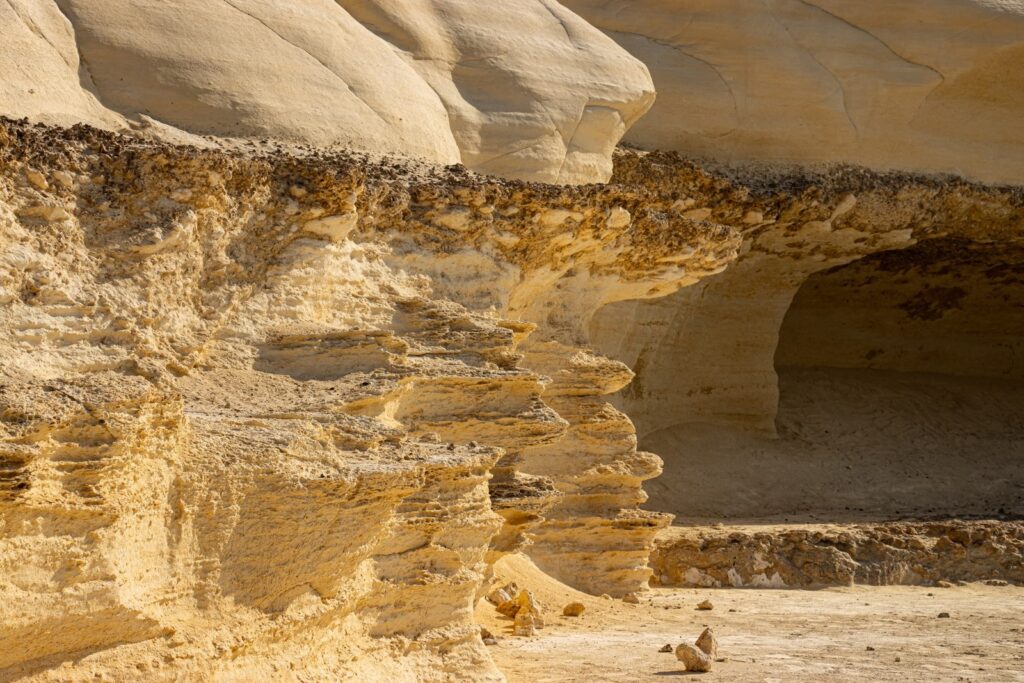
There is an image worth holding at the close of this Volume, and it is a genuinely old one, older than any framework this Circle has developed. Coastal stone, exposed for centuries to a specific, recurring shock, weather itself, does not survive by resisting the weather entirely. It survives by yielding, very slightly, in the specific ways the weather actually acts on it, so that the stone’s essential shape, its structural integrity, the load it can still bear, remains intact even as its surface continuously changes in response to what it has absorbed.
This is the correct image for the architecture this Volume has been describing. Not a fortress engineered to repel every shock without ever being touched by one. A structure engineered to be touched, repeatedly, by the specific classes of shock its own Risk Posture has already named, and to remain, after each touch, capable of bearing the load it was built to bear, having yielded exactly enough to absorb what arrived and no more.
The architect who has genuinely engineered this week’s three frameworks, on top of the sovereignty Volume I established, has built something closer to that stone than to that fortress. The fortress looks stronger in the moment before the first genuine shock arrives. The stone is what actually remains standing, in recognisable shape, after the shock has come and gone and come again.
Doctrine close
The architectures that last are not the ones that avoid shocks. They are the ones structurally engineered to weather them, repeatedly, absorbing each occurrence without losing their essential shape, and improving, slightly, in their capacity to absorb the next one.
This week’s three frameworks, the Contingency Architecture, the Instrumentation Doctrine, and the Regulatory Perimeter, are three faces of this single discipline, examined from the vantage points of time, perception, and terrain. None substitutes for the others. None substitutes for the sovereignty Volume I established as the precondition beneath all of them.
The Circle is a room of architects who have stopped mistaking an untested structure for a durable one, and who have done the harder, quieter work of building, testing, and repeatedly proving the capacity to weather what their own Risk Posture has already told them is coming.
Structure. Access. Positioning.
The Architect Circle is application only. Two hundred and fifty seats globally. createyourownmarket.com.au.